
I’ve always loved old things.
My great-grandpa’s rocking chair. A giant sprawling tree. Interesting rocks.
Not just because they’re old, but because they come with a history.
Continuing the Story
An empty canvas comes new, ready to receive something fresh — for the artist to pour their soul, and nothing else — onto the blank slate. But working with an old object is more complex. When I get my hands on an old Pepsi crate, a washboard, or sea shell, what’s most important is listening to what the object has to say.
It’s a life already lived that I wasn’t present for. It’s a mystery I’ll never know, but have the privilege of adding to. Maybe the washboard was used by the same mother of five for 20 years before it found its way into a dusty closet, an estate sale, an old man’s cluttered garage, and finally into my hands. It’s those stories I get to image in the dents and squeaks, the colorful layers of gemstones, the eroded crevices of a washed up seashell.
Each of these artworks has a story. One that started long before I picked up the paintbrush, but one that I have the privilege of refreshing.
Browse the photos
Read the story
Watch the process
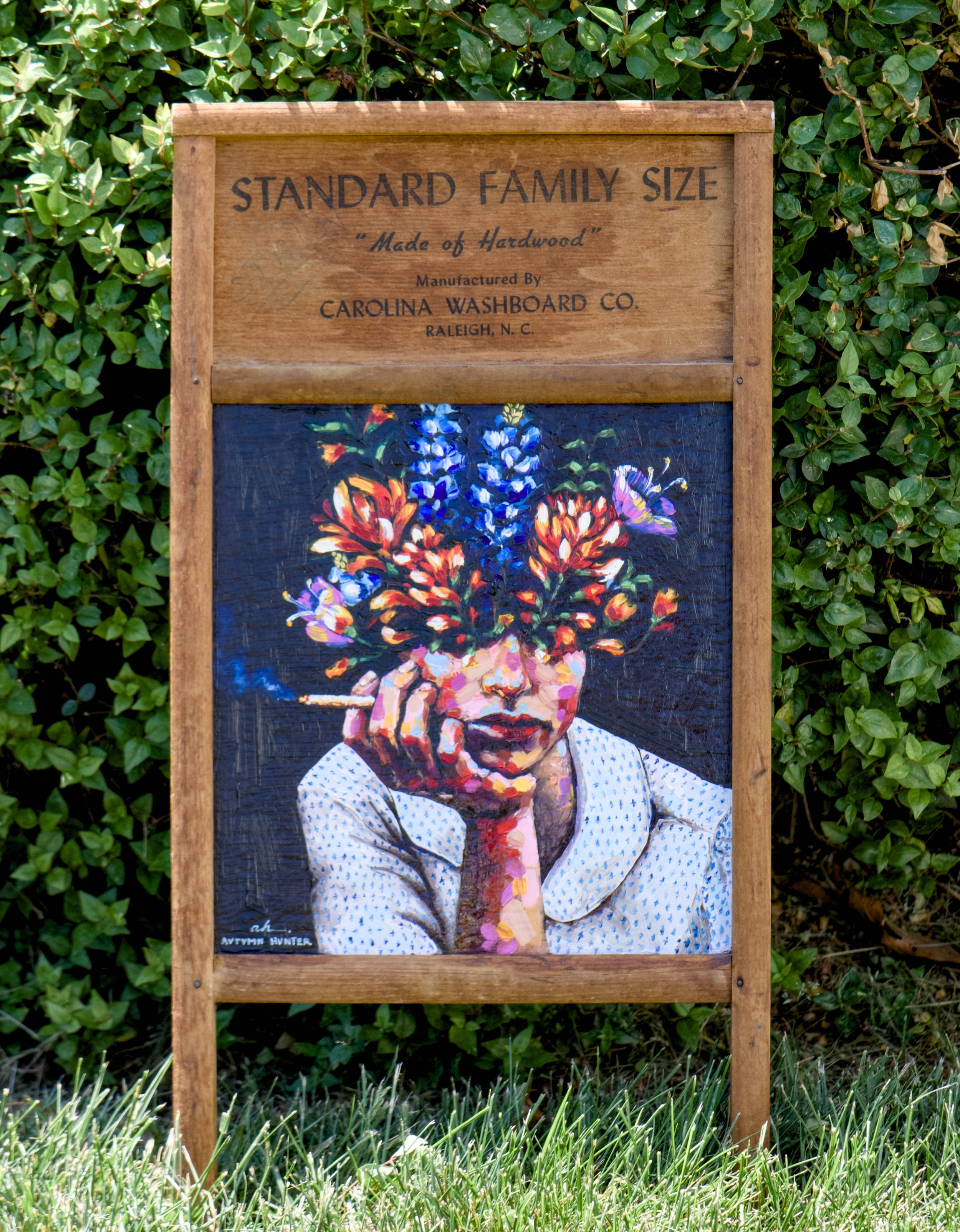
Oh, the life this piece has already lived…
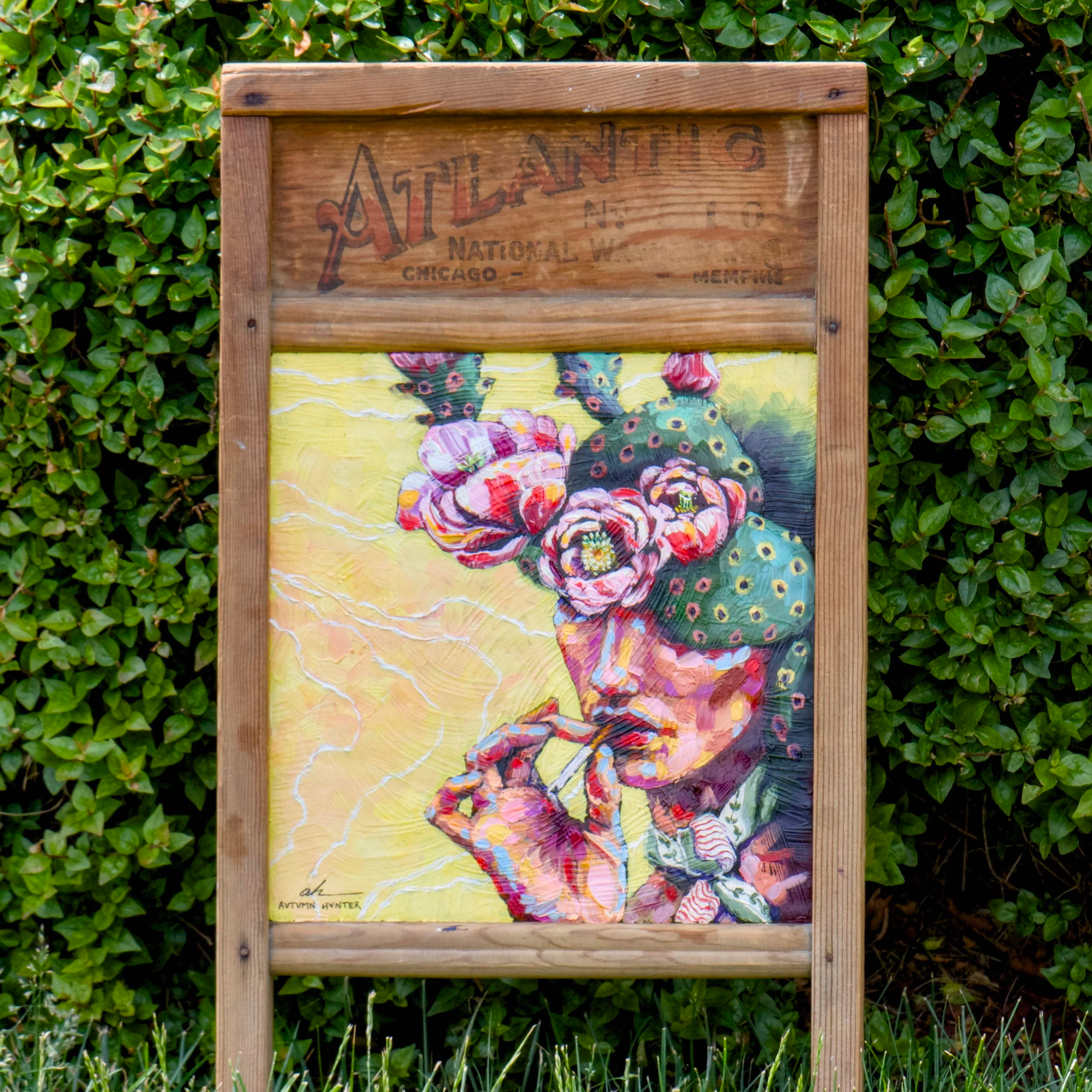
“Mommy’s Tired” was painted on a 1940’s washboard manufactured in my home city of Raleigh NC, something once used in the everyday repetitive work of caring for a family.
Now, this piece is about the same kind of labor, expressed in a new era. The late nights. The mental load. The beauty that still blooms in the middle of the daily chaos.
I love giving old objects a second life, especially ones that already carry history. Pieces like this don’t just sit on a wall. They bring texture and conversation into a space.
For the homes that mix old with new, polished with worn, softness with edge… this is for you.
Because sometimes the most meaningful pieces are the ones that have already lived a life before they found you.
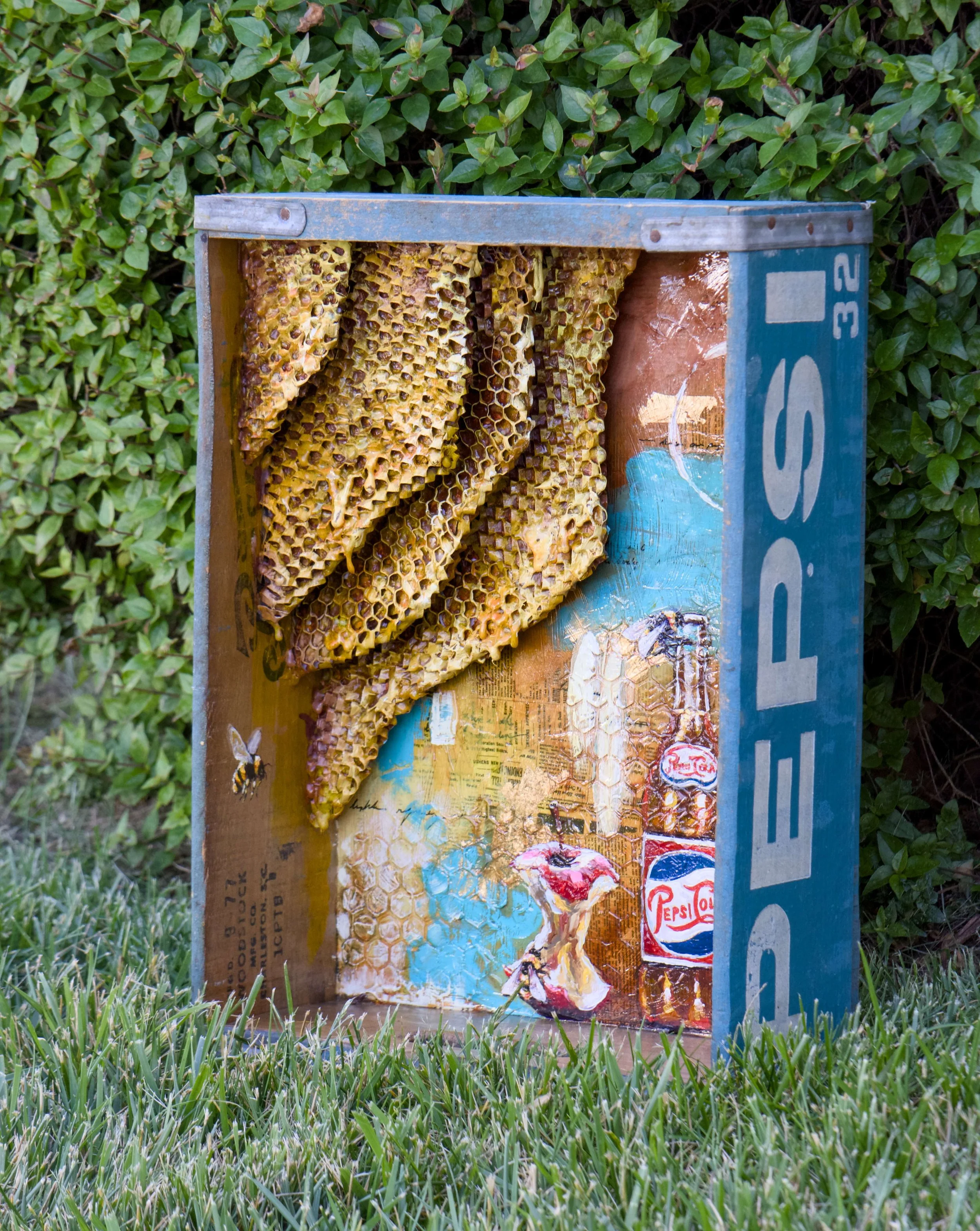
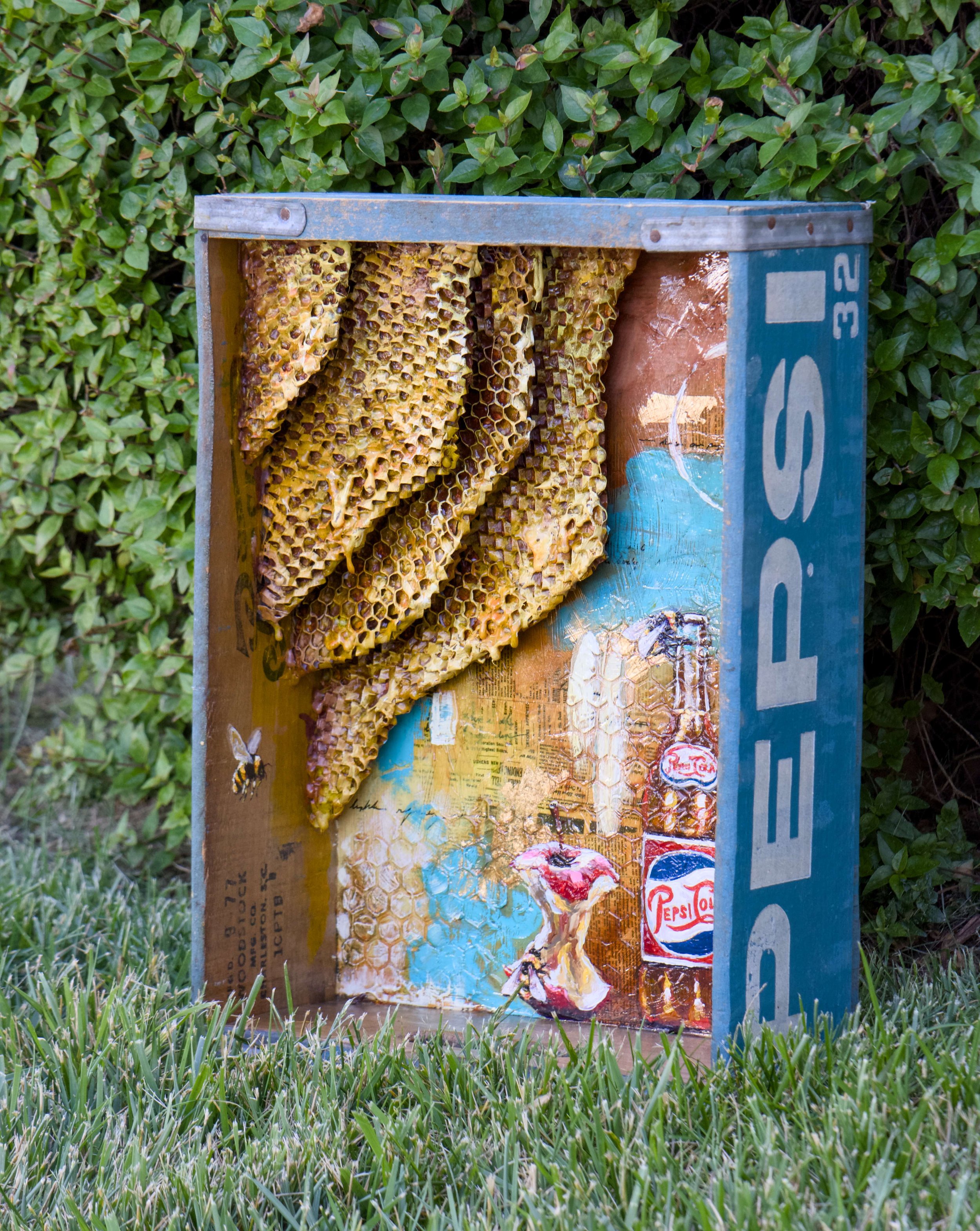
When I picked up this 1960s Pepsi crate from Facebook Marketplace, I started looking into the old ads. And they all told the same story… a woman sipping a Pepsi while a man watched. Even a soda was something you performed for someone else.
So I stripped it back. Layered in vintage newspaper, built up honeycomb and gold leaf, and filled it with bees and light and something sweet that exists for no one but itself.
“A thing to be savored” is about living in the present and enjoying every moment. It’s choosing pleasure over self-denial. Not excess or indulgence as a spectacle, just enjoying something simple without turning it into a moral problem.
This is for the ones who are their harshest critic. Who just see the weight on the scale, who mull over mistakes made yesterday, and feel too guilty to enjoy a simple moment for themselves.
This is your reminder to savor the sweetness of life.
I love giving old objects a second life, especially ones that carry a story worth rewriting. Pieces like this don’t just sit on a wall. They start a conversation before anyone even asks about them.
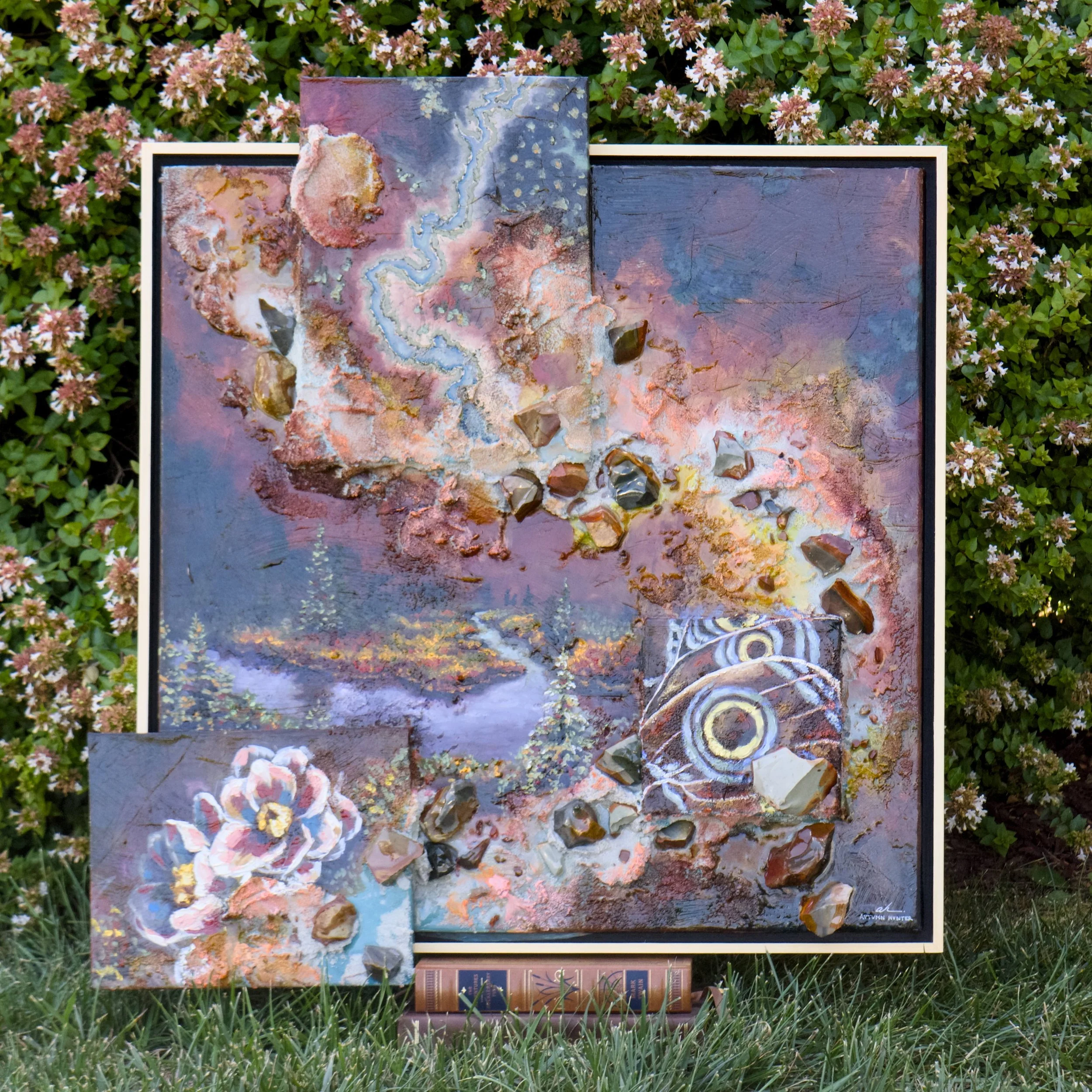
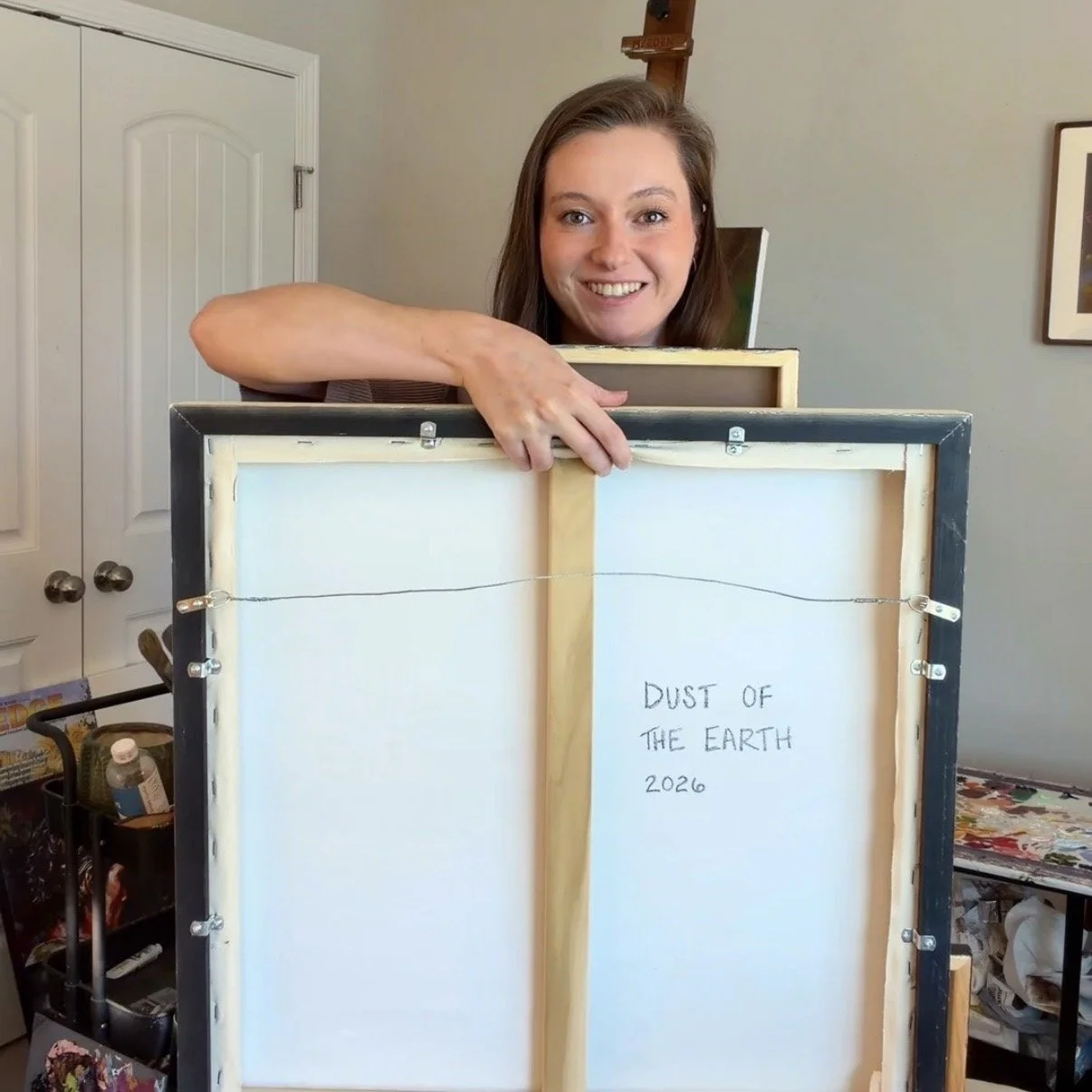
This painting started out as a story about us. It ended up being a story about where we live.
I've been thinking lately about how long everything took. The volcanic events, the pressure, the chemistry, the slow accumulation of one layer onto the next. The survival. The adaptation. All of it had to happen, in that order, for us to be here now… and we've only just arrived. We are a blip at the very end of a very long story.
Ask anyone how the world was made and they'll tell you from where they're standing. Their vantage point, their narrative, what they've been told. I wanted to see it from every angle at once, the way God sees it. The way the rocks see it. So each panel sits at a different scale: a landscape at eye level, the way a person or an animal would meet it. A desert river from above, the way a bird crosses it. A butterfly's wing so close it stops being a wing. A flower, held still long enough to be the sole focus. Same earth. Four witnesses.
The canvases are stepped and layered, the way strata are, each one set at its own depth.
The stones are desert jasper, found in Madagascar and mined by hand. It takes millions of years to form: volcanic ash and mineral chemistry pressed into those sunset-colored layers. I keep returning to rocks because they're the only witnesses I can actually hold. They were here long before I was. They were there for the parts I'm asking about.
This is a painting about the earth, and about what we're made of. The dust.
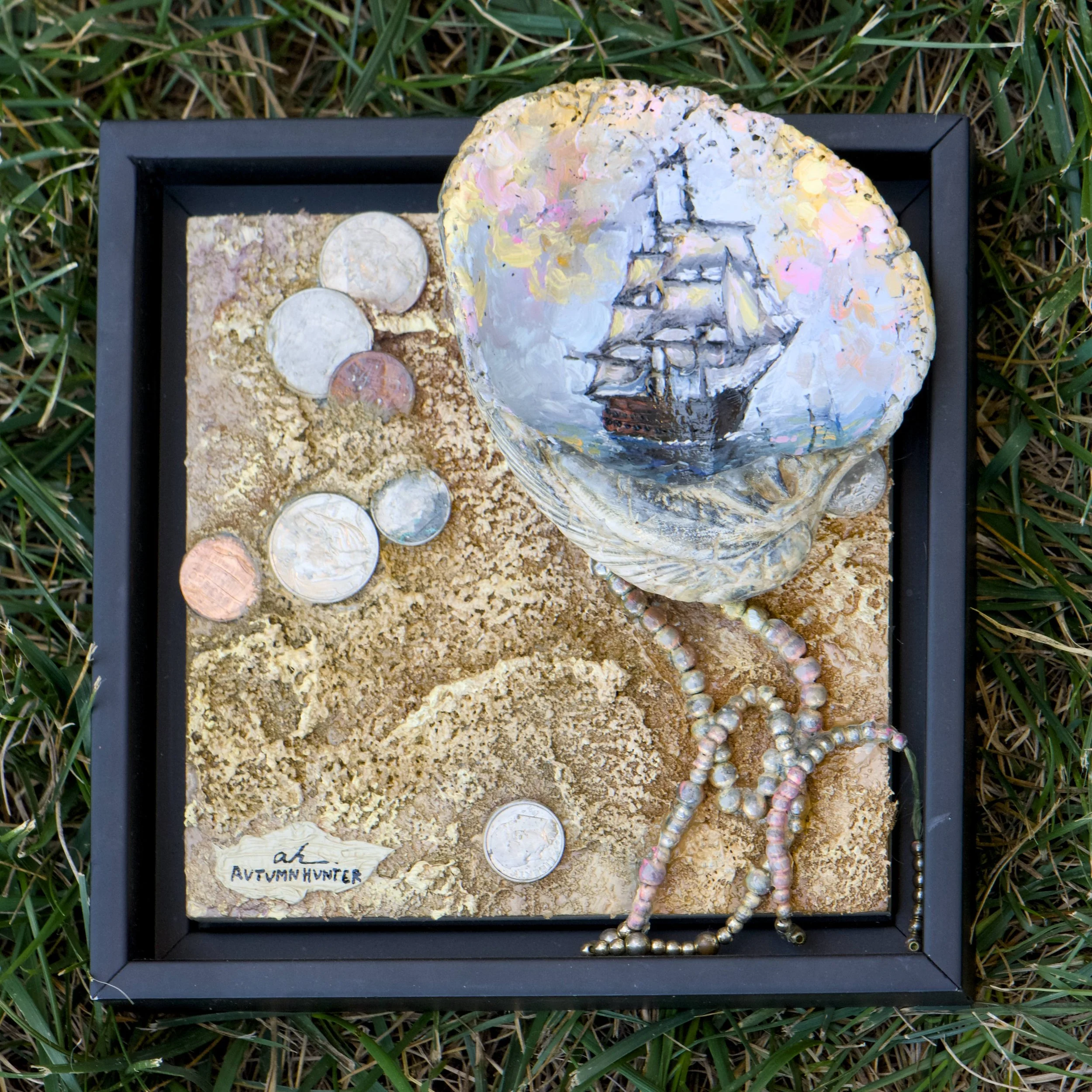
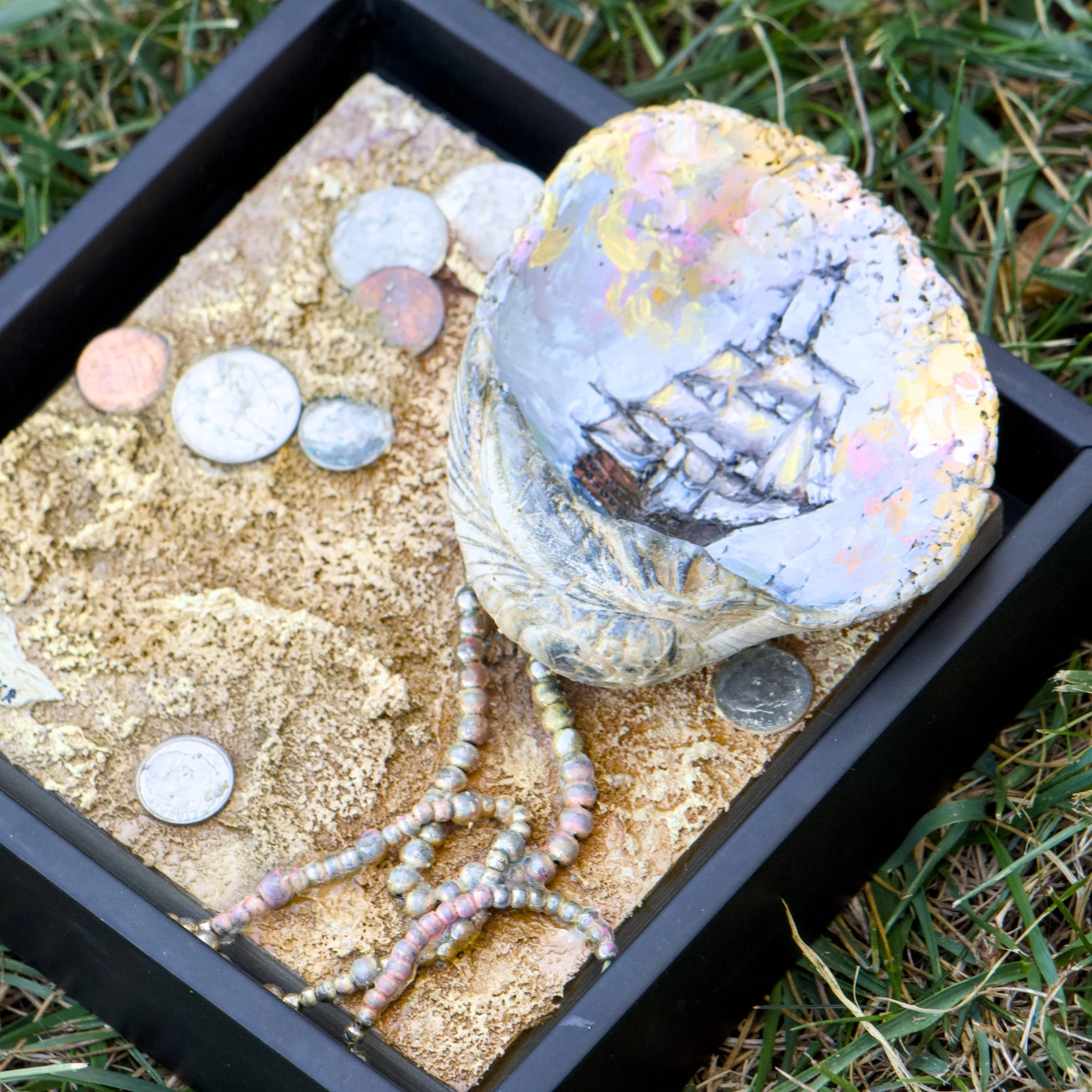
A year ago, I found this weathered sea shell on the beach at Kitty Hawk, NC. Ever since, it’s been on my bathroom vanity holding my bracelets and spare change.
Well… at some point the bracelets tarnished, the change looked dingy, and I thought the shell deserved more.
So I started to see a story being told. One of all the untold stories lost to sea in a storm down through time. Before cell phones. Before airlines. When all you had was your luggage, a boarding pass, and faith that you would reach your destination safely… in a few weeks. For most of human history, there was no phoning for help. Whatever happened out there happened. And maybe by luck, a few coins and a bracelet would wash up as the only evidence you ever existed.
I built this piece around that mystery. The shell is real. It’s been sitting on my dresser collecting my spare change. The bracelets were tarnishing. The ship inside is sailing into a sky that looks a little too bright for how things are about to go.
The sea holds many secrets, and I hope this captures its beauty.
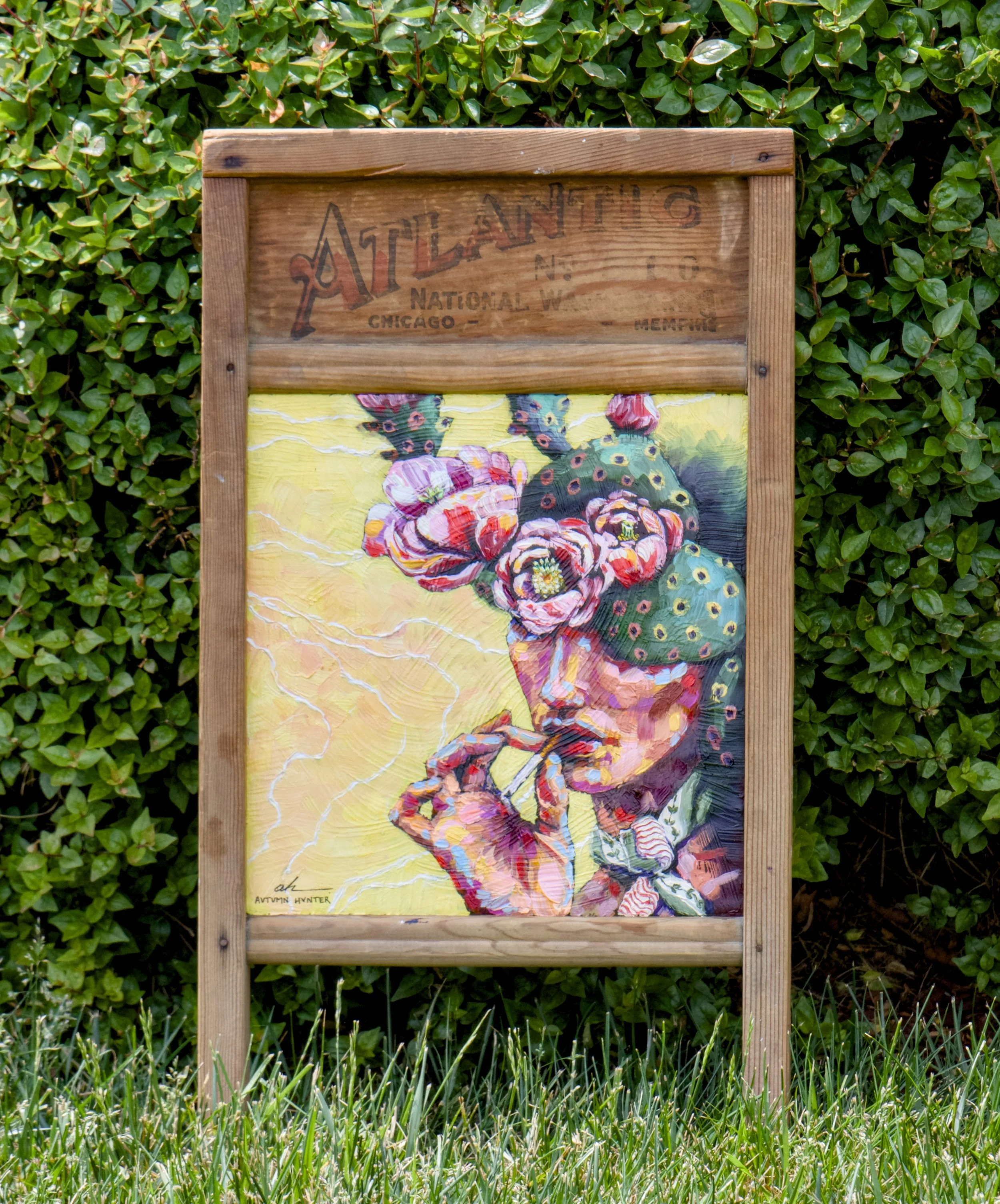
This one just tells the truth (not the highlight reel).
“Mommy’s Last Nerve” is painted on a vintage washboard from the 1940’s that’s already lived a whole life before this one.
As an autistic mother of two toddler boys, I feel overstimulated most of the time. I love their energy, creativity, and unwavering confidence when exploring the world, but motherhood is a lot. It’s not something that a parent can explain to you before you become one. Sacrifice isn’t something taught. However annoying it is to hear, it truly is one of those things that “you’ll understand when you have a child of your own.”
All the parents out there know what this moment feels like. You’ve had it up to here with being jumped on, begged for snacks, and talked out of naptime. It’s a prickly, exhausting, IDGAF kind of feeling… good thing kids are cute!
I love using objects like this for the history, the wear, the proof of everything they’ve been through. It felt right for a piece about that edge we all reach sometimes… when you’re stretched thin but still showing up, still holding it together, still choosing patience when you can (maybe not every day 😉).
I’m always drawn to pieces that feel collected, not curated. The kind that look like they’ve been found over time, each one carrying a little story with it.
For the homes that lean into character, contrast, and conversation… this is one of those pieces.
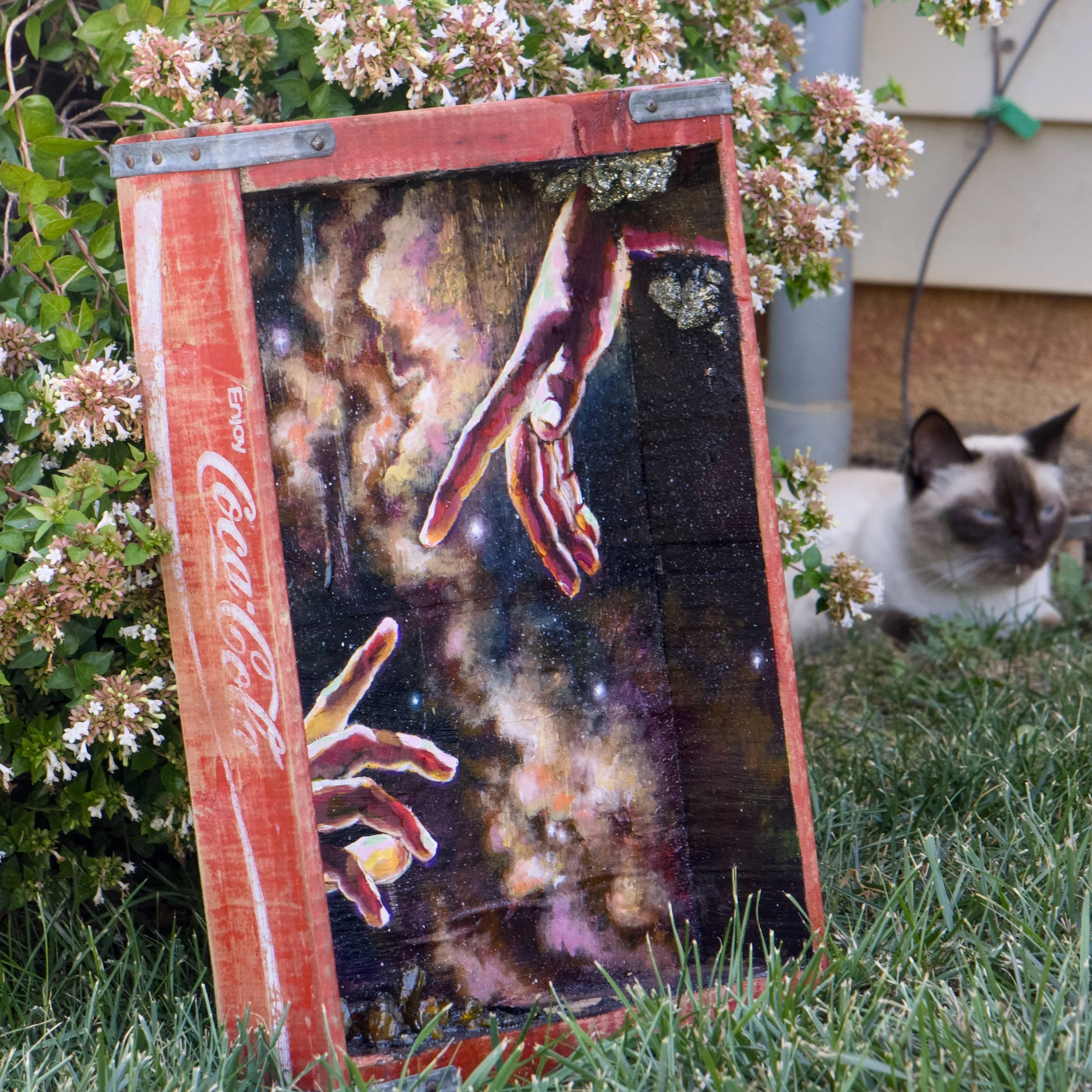
There’s a reason Michelangelo’s “Creation of Adam” has never lost its power to move people.
One of the beautiful things about existence is that no matter your religion or beliefs, we are always trying to touch God. To understand our universe. To get closer to the source.
It’s a lifelong endeavor and we never fully understand what we’re chasing after, but I’m positive that this desire is deeper than simply a need for purpose. It’s knowing that we actually have one.
Old objects like this Coca-Cola crate inspire me because I see a portal to another world, not just something old. I wanted to highlight outer space in this painting because it’s so vast and unexplored. It represents something so great that it can never be fully comprehended.
I chose to use baltic amber and pyrite to enhance the story. Baltic amber has a warm, semi-transparent glow that looks very earthy to me, so I chose to place it beside the lower hand to represent humanity. Pyrite, on the other hand (pun intended), looks otherworldly, so I chose to use it to represent the higher power, or God.
Originally when I received this crate, I wanted the artwork to be about togetherness. That’s what the Coca-Cola brand has historically been about. Sharing something… together. Clearly, that sentiment morphed into exploring life’s bigger questions.